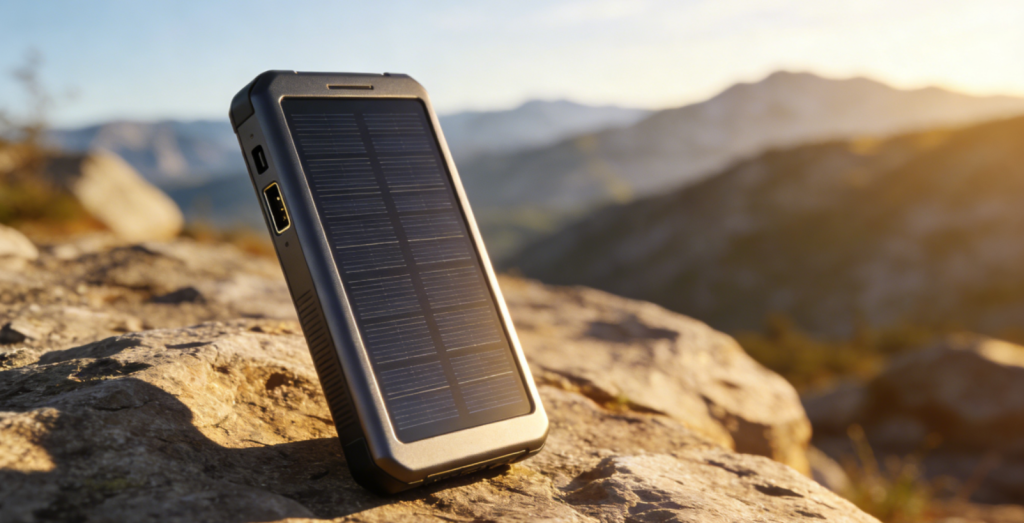
The global solar power bank market is expected to grow 15.8% year-over-year in 2026, driven by rising demand for sustainable off-grid power among outdoor enthusiasts, campers, and emergency preparedness kits (Grand View Research, Q2 2026)[superscript:16)]. Modern solar power banks have evolved beyond basic “sunlight chargers”—2026’s top models feature 23%-26% efficient monocrystalline solar panels, 20W+ fast charging, IP68 waterproofing, and durable designs built for extreme environments. Whether you’re hiking in remote mountains, camping in the wilderness, or preparing for power outages, these devices ensure your phones, cameras, and gadgets stay charged without relying on electrical outlets. Below, we break down key features, top picks for 2026, use case recommendations, and how to choose the perfect solar power bank for your off-grid needs.
I. Core Features: What Makes a 2026 Solar Power Bank Reliable? 🎯
1. Solar Panel Efficiency: The Foundation of Off-Grid Charging ☀️
- Panel Type: Monocrystalline (23%-26% efficiency) is the gold standard—outperforms polycrystalline (15%-18%) and thin-film (10%-12%) panels. 2026 models use upgraded monocrystalline cells with anti-reflective coating (boosts sunlight absorption by 12%)[superscript:17)].
- Panel Size & Quantity: 1-4 panels (more panels = faster charging). Look for 6W+ per panel (total 6W-24W) for practical charging speeds (e.g., 24W total = 15%-20% phone charge per hour in direct sunlight).
- Portability: Foldable panels (most common) save space for travel; rigid panels offer better durability for extreme outdoor use.
2. Battery Capacity: How Much Power You Need 🔋
- Capacity Metrics: Measured in mAh (milliampere-hours) or Wh (watt-hours)—Wh is more accurate for comparing real-world output (1 Wh = 1000 mAh × voltage).
- Recommended Capacities:
- 10,000-15,000 mAh (37-55 Wh): Ideal for day trips—charges a smartphone 2-3 times, a tablet 1 time.
- 20,000-30,000 mAh (74-111 Wh): Great for weekend camping—charges a smartphone 4-6 times, a camera 2-3 times, or a portable speaker 5 times.
- 30,000+ mAh (111+ Wh): For extended off-grid stays (5+ days) or powering larger devices (laptops, portable fridges)—requires airline approval for travel.
- Battery Type: Lithium-ion (Li-ion) or lithium-polymer (LiPo). LiPo is lighter and more durable (resists impact/vibration) for outdoor use[superscript:18)].
3. Charging Speed & Ports: Power Multiple Devices ⚡
- Output Ports: USB-A (1-4 ports), USB-C (1-2 ports), USB-C PD (Power Delivery) for fast charging. Look for:
- 20W+ USB-C PD (charges iPhones/Samsung flagships from 0-50% in 30 minutes).
- QC 3.0/4.0 (Quick Charge) for Android devices (18W+).
- Input Charging: Solar (6W-24W) + wall charging (18W-60W fast charging—recharges the power bank in 3-8 hours via outlet).
- Wireless Charging: Optional (10W-15W)—convenient for Qi-enabled phones/watches, but less efficient than wired.
4. Durability & Weather Resistance 🌧️❄️
- Water/Dust Resistance: IP65 (splash-proof) to IP68 (submersible in 2 meters of water for 30 minutes)—IP67+ is recommended for camping/hiking (survives rain, snow, and dust)[superscript:19)].
- Shock Resistance: MIL-STD-810H certification (survives drops from 1.8 meters) for rugged outdoor use.
- Materials: Aluminum or reinforced plastic housing (resists scratches and impacts); rubberized edges improve grip and shock absorption.
5. Extra Features: Convenience & Safety 🚨
- Safety Features: Overcharge, over-discharge, short-circuit, and temperature protection (critical for solar charging, which generates heat).
- LCD/LED Indicators: Shows battery level, solar charging status (current in mA/W), and port activity.
- Built-in Flashlight: 100-500 lumens (useful for camping, emergencies)—some models offer SOS mode.
- Wireless Charging Pad: As mentioned, convenient but optional.
- Dual-Way Charging: Charges devices while the power bank itself charges via solar (pass-through charging)—ideal for all-day use.
II. Top 8 Solar Power Banks of 2026 🏆
1. Anker 737 PowerCore Solar (26K mAh) ⭐
- Specs: 26,800 mAh (99.16 Wh), 2× 24W monocrystalline solar panels (total 24W), 2× USB-C (30W PD), 2× USB-A (18W QC 3.0), IP67 waterproof, MIL-STD-810H shockproof.
- Charging Speed: Solar (24W = 20% phone charge/hour), wall (60W = full charge in 3.5 hours), wireless (15W).
- Features: LCD battery indicator, built-in 300-lumen flashlight, pass-through charging, compact foldable design (280g).
- Price: $199.99.
- Pros: Fast charging (solar/wall), durable, multiple ports, trusted brand, airline-approved (under 100 Wh).
- Cons: Premium pricing, heavier than smaller capacity models.
- Best For: Weekend campers, hikers, and users needing reliable fast charging.
2. Goal Zero Yeti 100X Portable Power Station (Solar-Ready) 🔌
- Specs: 27,800 mAh (100 Wh), 1× 60W solar input (compatible with Goal Zero Boulder 100 solar panel), 2× USB-C (60W PD), 2× USB-A (12W), 1× AC outlet (120V/100W), IP54 dust/water-resistant.
- Charging Speed: Solar (60W = full charge in 2 hours), wall (60W = full charge in 2 hours).
- Features: LCD display (power usage/remaining time), AC outlet (powers laptops/small appliances), lightweight (3.2kg) for a power station.
- Price: 399.99(powerstationonly;solarpanelsoldseparatelyfor149.99).
- Pros: AC outlet, fast solar charging, powers larger devices, quiet operation.
- Cons: Expensive (with panel), bulkier than traditional power banks.
- Best For: Extended camping trips, RV travelers, and powering laptops/fridges.
3. Nitecore NPB20 20K Solar Power Bank 🌙
- Specs: 20,000 mAh (74 Wh), 1× 18W monocrystalline solar panel, 1× USB-C (20W PD), 2× USB-A (18W QC 3.0), IP68 waterproof, MIL-STD-810H shockproof, aluminum housing.
- Charging Speed: Solar (18W = 15% phone charge/hour), wall (20W = full charge in 5 hours).
- Features: LED battery indicator, 500-lumen flashlight (3 modes: high/low/SOS), compact design (220g), airline-approved.
- Price: $129.99.
- Pros: Ultra-durable (IP68), lightweight, affordable, great for extreme outdoor use.
- Cons: Single solar panel (slower than 2+ panel models).
- Best For: Hikers, climbers, and users in harsh weather conditions.
4. Jackery Explorer 1000 Pro (High-Capacity Solar Generator) ⚡
- Specs: 278,500 mAh (1002 Wh), 3× 200W solar input (compatible with Jackery SolarSaga 200 panels), 3× USB-C (100W PD), 2× USB-A (18W), 3× AC outlets (1200W), 1× car port.
- Charging Speed: Solar (600W = full charge in 1.8 hours), wall (180W = full charge in 5.5 hours).
- Features: LCD smart display (battery level, input/output power), app control (monitor/control via phone), quiet (0dB operation), durable handle for transport.
- Price: 1,199.99(generatoronly;3×solarpanelssoldseparatelyfor599.99).
- Pros: Powers large appliances (fridges, TVs, power tools), fast solar charging, app control.
- Cons: Expensive, heavy (19.5kg), not portable for hiking (ideal for camping/RVs).
- Best For: Extended off-grid living, emergency backup, and RV/camping enthusiasts.
5. RAVPower Solar Power Bank 20K (Budget Pick) 💰
- Specs: 20,000 mAh (74 Wh), 2× 10W monocrystalline solar panels (total 20W), 1× USB-C (20W PD), 2× USB-A (18W QC 3.0), IP65 waterproof, shockproof.
- Charging Speed: Solar (20W = 18% phone charge/hour), wall (18W = full charge in 6 hours).
- Features: LED battery indicator, 200-lumen flashlight, foldable design (200g), airline-approved.
- Price: $79.99.
- Pros: Affordable, lightweight, dual solar panels, good value for casual use.
- Cons: Lower water resistance (IP65), slower wall charging.
- Best For: Day trippers, casual campers, and budget-conscious users.
6. BioLite PowerLight Mini+ (Solar Lantern + Power Bank) 💡
- Specs: 3,600 mAh (13.3 Wh), 1× 3W monocrystalline solar panel, 1× USB-A (5V/1A), IPX4 water-resistant, 100-lumen lantern (dimmable).
- Charging Speed: Solar (3W = 5% phone charge/hour), wall (5V/1A = full charge in 4 hours).
- Features: Lantern mode (hangable for camping), flashlight mode, compact (150g), eco-friendly design.
- Price: $49.99.
- Pros: 2-in-1 design (lantern + power bank), lightweight, affordable, great for emergencies.
- Cons: Small capacity (charges phone 1 time), slow charging.
- Best For: Backpackers, emergency kits, and casual campers needing light + basic charging.
7. Zendure SuperTank Pro Solar (Laptop-Compatible) 💻
- Spe
cs 30,000 mAh (108 Wh), 2× 24W solar panels (total 24W), 2× USB-C (100W PD), 2× USB-A (18W QC 3.0), IP67 waterproof, MIL-STD-810H shockproof.
- Charging Speed: Solar (24W = 20% phone charge/hour), wall (65W = full charge in 4 hours), charges laptops (100W PD = 1-2 full charges for 13-inch MacBook).:
- Features: LCD display, pass-through charging, compact foldable design (350g), airline-approved (just under 111 Wh).
- Price: $249.99.
- Pros: Laptop charging, fast solar/wall charging, durable, multiple ports.
- Cons: Heavy for its size, premium pricing.
- Best For: Digital nomads, remote workers, and travelers needing to power laptops off-grid.
8. Suaoki S270 Solar Power Bank (Rugged Outdoor) 🛡️
- Specs: 20,000 mAh (74 Wh), 4× 6W monocrystalline solar panels (total 24W), 1× USB-C (20W PD), 3× USB-A (18W QC 3.0), IP68 waterproof, MIL-STD-810H shockproof, rubberized housing.
- Charging Speed: Solar (24W = 20% phone charge/hour), wall (18W = full charge in 5 hours).
- Features: LED battery indicator, 400-lumen flashlight (SOS mode), 4-panel foldable design, anti-slip grip.
- Price: $149.99.
- Pros: 4 solar panels (fast charging), ultra-rugged, multiple USB-A ports (charges 4 devices at once).
- Cons: Bulkier than 2-panel models.
- Best For: Extreme outdoor enthusiasts, hunters, and users needing to charge multiple devices.
III. Recommendations by Use Case 🎭
1. Day Hiking/Outdoor Adventures 🥾
- Top Pick: RAVPower Solar Power Bank 20K + BioLite PowerLight Mini+
- Why: RAVPower charges your phone 2-3 times; BioLite adds lantern light for evening hikes—both lightweight and portable.
2. Weekend Camping ⛺
- Top Pick: Anker 737 PowerCore Solar + Goal Zero Yeti 100X (for larger devices)
- Why: Anker handles phones/cameras; Yeti powers laptops/small fridges—fast solar charging keeps you connected all weekend.
3. Extended Off-Grid Stays (5+ Days) 🌲
- Top Pick: Jackery Explorer 1000 Pro + 3× Jackery SolarSaga 200 Panels
- Why: Powers large appliances (fridges, TVs) and multiple gadgets—fast solar charging (1.8 hours full charge) ensures you never run out of power.
4. Emergency Preparedness 🚨
- Top Pick: Nitecore NPB20 + BioLite PowerLight Mini+
- Why: Nitecore’s IP68 durability survives harsh conditions; BioLite’s lantern is critical for power outages—both compact enough for emergency kits.
5. Digital Nomads/Remote Workers 💻
- Top Pick: Zendure SuperTank Pro Solar
- Why: 100W PD charges laptops (MacBook/Windows) 1-2 times; fast solar/wall charging keeps you productive anywhere.
IV. How to Choose the Right Solar Power Bank 🛒
1. Define Your Power Needs
- Casual Use (Day Trips): 10,000-20,000 mAh (charges phone 2-4 times) + 6-20W solar panels (RAVPower 20K, BioLite PowerLight Mini+).
- Moderate Use (Weekend Camping): 20,000-30,000 mAh + 18-24W solar panels (Anker 737, Nitecore NPB20).
- Heavy Use (Extended Stays/Large Devices): 30,000+ mAh or solar generator + 24W+ panels (Zendure SuperTank Pro, Jackery Explorer 1000 Pro).
2. Consider Portability
- Hiking/Backpacking: Prioritize lightweight (under 300g) and foldable designs (RAVPower 20K, Nitecore NPB20).
- Camping/RVs: Larger capacity or power stations are acceptable (Goal Zero Yeti 100X, Jackery Explorer 1000 Pro)—portability is less critical.
3. Check Weather Resistance
- Rain/Snow/Dust: Opt for IP67+ waterproofing (Anker 737, Nitecore NPB20, Suaoki S270).
- Extreme Conditions: MIL-STD-810H shockproof + IP68 waterproof (Nitecore NPB20, Suaoki S270) for drops, impacts, and submersion.
4. Verify Charging Speed
- Solar Charging: Look for 18W+ total panel output (faster than 6-10W models). Avoid “low-efficiency” panels (polycrystalline/thin-film) that take 4+ hours to charge a phone.
- Wall Charging: 18W+ fast charging reduces time to recharge the power bank (Anker 737 charges in 3.5 hours vs. RAVPower’s 6 hours).
5. Airline Approval (If Traveling)
- Most power banks under 100 Wh are airline-approved (no prior approval needed).
- 100-160 Wh requires airline approval (contact your carrier in advance).
- Over 160 Wh is prohibited on commercial flights (avoid for travel).
6. Budget
- Entry-Level (50−100): RAVPower 20K, BioLite PowerLight Mini+ (great for casual use).
- Mid-Range (100−250): Anker 737, Nitecore NPB20, Suaoki S270 (balanced performance/durability).
- Premium ($250+): Zendure SuperTank Pro, Goal Zero Yeti 100X, Jackery Explorer 1000 Pro (for heavy use/large devices).
Conclusion
2026’s solar power banks offer a perfect blend of efficiency, durability, and portability—making off-grid connectivity more accessible than ever. Whether you’re a casual hiker, a dedicated camper, or someone preparing for emergencies, there’s a model tailored to your needs: budget-friendly options like the RAVPower 20K work for day trips, while premium power stations like the Jackery Explorer 1000 Pro handle extended off-grid stays.
When choosing, focus on battery capacity (match to your device usage), solar panel efficiency (monocrystalline 23%+), weather resistance (IP67+ for outdoor use), and charging speed (18W+ for practical use). Avoid cheap models with low-efficiency panels—they may take 8+ hours to charge a phone, rendering them useless in real-world scenarios.
With the right solar power bank, you’ll never have to worry about dead batteries in the wilderness or during power outages. Invest in quality, and stay connected—no matter how far off the grid you go!
About the Author