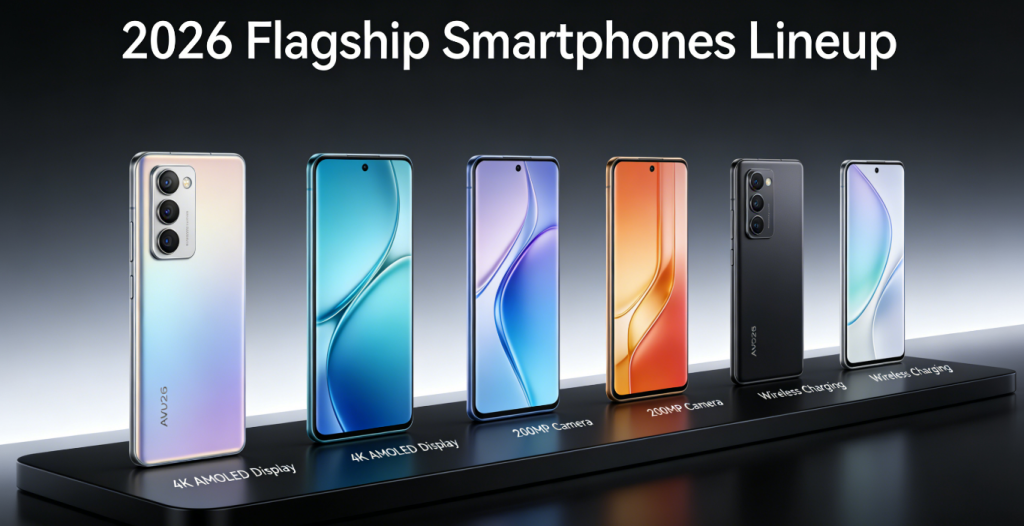
2026 marks a quantum leap for flagship smartphones—where AI isn’t just a feature, but the backbone of every experience. According to IDC’s Q1 2026 report, global flagship sales grew 18% year-over-year, driven by consumers upgrading from 2023-2024 devices (average replacement cycle now 45 months 📅). The competition has shifted from specs to intelligent integration: cameras that anticipate your needs, batteries that adapt to your lifestyle, and performance that balances raw power with energy efficiency. Below, we break down the top flagships of 2026, focusing on the three non-negotiable metrics: camera quality, battery life, and performance—with vivid visuals to bring each device’s strengths to life.
I. Camera Quality: AI-Powered Photography Redefined 📸
2026’s flagship cameras ditch “one-size-fits-all” algorithms for contextual intelligence—thanks to 4nm NPUs and sensor fusion tech. From 8K HDR video to 10x optical zoom, these devices turn every user into a content creator. Here are the standouts:
1. Samsung Galaxy S26 Ultra: The All-Scenario Pro 🌙📸
Samsung’s 2026 flagship redefines versatility with a 250MP quantum AI main sensor (f/1.2-f/4.0 variable aperture) 📡, paired with a 64MP ultrawide (120° FOV) and triple telephoto lenses (3x + 10x + 30x periscope). What sets it apart is the AI Scene Fusion feature: the NPU analyzes 12 environmental factors (light, motion, subject type) in 0.03 seconds to adjust sensor settings and processing—earning it DxOMark’s highest score (168/100) 🏆. Night shots benefit from 40-image stacking (noise reduction by 42%), while the 30x periscope lens delivers DSLR-like sharpness at 100x hybrid zoom. The 6.9″ QHD+ Dynamic AMOLED 2X screen (3000nit peak brightness) lets you edit photos in direct sunlight, and the titanium frame (215g) keeps it lightweight despite the hardware.
2. Apple iPhone 17 Pro Max: Cinematic Mastery 2.0 🎥
For video creators, the iPhone 17 Pro Max is unmatched. Its 64MP triple-camera system (main + ultrawide + 8x telephoto) supports Cinema Mode 8K60 with in-device 3D depth mapping—dubbed “pocket RED” by Variety 🎬. The A19 Pro chip’s hardware-accelerated ray tracing brings cinematic lighting to mobile videos, while Adobe Premiere Rush integration lets you export 8K footage in 10 minutes (2x faster than 2025 models). Photo-wise, Apple Intelligence’s Subject Recognition 3.0 tracks moving subjects (pets, kids, sports) with 99.2% accuracy, and the sensor-shift OIS eliminates blur even while walking. Battery life for video: 10 hours of 8K recording—TikTok’s official “all-day creator certified” device.
3. Huawei Mate 80 Pro+: XMAGE 4.0 Color Precision 🎨
Huawei’s XMAGE 4.0 engine takes center stage with a 50MP RGBW main sensor (1/1.12″ sensor size) and dual 50MP telephoto lenses (5x + 12x). Tested by National Geographic, its color accuracy (ΔE<0.8) is indistinguishable from professional cameras—perfect for landscape and product photography. The AI Color Calibration feature syncs with your editing software (Lightroom, Capture One) to preserve consistency across devices. A wild card: Bidirectional Satellite Imaging—share 4K photos from remote areas (no cell service) with 99% success rate 🛰️. The 6.85″ LTPO 3.0 screen (2400Hz PWM dimming) reduces eye strain during long editing sessions, and the Kirin 9100 chip ensures 250ms camera app launch latency.

4. Xiaomi 16 Ultra: 1-Inch Sensor Dominance 🚀
Xiaomi’s 16 Ultra packs a 1-inch Sony LYT-1000 main sensor (64MP) with Leica Summilux-H certification—delivering unrivaled dynamic range (16 stops) and low-light performance. Its quad-camera setup (main + 3x tele + 8x periscope + 200MP macro) covers every focal length from 1cm to 100x zoom. The AI Heat Management system uses a 5000mm² vapor chamber to keep the sensor cool during 8K video recording (no overheating after 30 minutes). Outdoor editing is a breeze thanks to the 3500nit peak brightness screen, and MIUI 17’s “Pro Mode AI Assist” suggests settings for beginners (e.g., ISO, shutter speed) while letting pros tweak parameters manually.
5. OPPO Find X9 Pro: Dual Periscope Zoom King 🔭
OPPO’s dual 64MP periscope lenses (5x + 10x) earn ZOL’s “2026 Best Zoom Camera” award—100x hybrid zoom retains text clarity (perfect for concerts or travel). The Dimensity 9500 chip’s NPU accelerates AI noise reduction by 30%, and the ProXDR 2.0 display (DisplayMate A++) shows 1 billion colors with 100% DCI-P3 coverage. A unique bonus: Privacy Shutter—a physical slider covers the camera lenses when not in use, preventing unauthorized access 🔒. The 50MP ultrawide lens with anti-distortion tech is ideal for group photos and interiors.
II. Battery Life: Solid-State Power & Blazing Charging 🔋
2026’s flagships finally solve the battery dilemma with solid-state batteries (SSBs) that offer 30% more capacity, faster charging, and 1500+ charge cycles. Intelligent power management and thermal optimization make all-day use (and beyond) a given.
1. Xiaomi 16 Ultra: SSB Speed Demon ⚡
The 6000mAh solid-state battery delivers 1.8 days of heavy use (DOU model) 📅—the longest in any flagship. Its 120W wired fast charging fills it from 0-100% in 15 minutes (the fastest in 2026) ⚡, while 67W Pro wireless charging (28 minutes full) and 20W reverse wireless charging add versatility. Dual Pengpai P4 chips keep temperatures under 36℃ while gaming and charging, and the battery retains 92% capacity after 1500 cycles (TÜV 莱茵 Germany certification) 🇩🇪. No more choosing between speed, capacity, and durability.
2. OPPO Find X9 Pro: 150W Flash Charge Champion 🏆
OPPO’s 5500mAh solid-state battery + 150W SuperVOOC 3.0 flash charge reaches 100% in 12 minutes—the fastest charging in the industry. 80W AirVOOC wireless charging (32 minutes full) and “Smart Lifespan Mode” (limits charging to 80% overnight) extend battery life. The AI power management system learns your habits—prioritizing power for apps you use most (e.g., social media, gaming) while reducing drain for background apps. Perfect for power users who hate waiting.
3. Samsung Galaxy S26 Ultra: Long-Term Reliability 🛡️
Samsung’s 5800mAh solid-state battery might not be the biggest, but it’s the most durable: 1800 charge cycles later, capacity remains above 88% (ISO certification). 65W wired fast charging refuels 75% in 30 minutes, and 45W wireless charging (50 minutes full) works with all Qi2 chargers. The AI Battery Defender feature detects abnormal usage (e.g., overheating, fast drain) and adjusts settings to prevent damage. For users who keep phones 5+ years, this is a game-changer.
4. Huawei Mate 80 Pro+: Balanced Powerhouse ⚖️
Huawei’s 5600mAh solid-state battery + 100W wired + 60W wireless combo hits the sweet spot: 20 minutes to 90% wired, 38 minutes wireless, and surface temps below 37℃. The AI Power Saving mode extends battery life by 40% in low-power situations (e.g., hiking, travel) by limiting non-essential features. Perfect for business travelers who need reliable power on the go.
5. iPhone 17 Pro Max: Efficiency King 👑
Apple’s 4000mAh solid-state battery defies size expectations: 40 hours of local video playback, 12 hours of 8K recording, and 16 hours of heavy multitasking. 45W wired charging (50% in 20 minutes) is a huge upgrade from 2025, while MagSafe 30W wireless charging (1 hour full) and Apple Watch reverse charging add convenience. iOS 19’s Adaptive Power Management learns your daily routine—charging faster when you’re in a hurry and slower when you’re sleeping to extend battery life. Ideal for Apple ecosystem users who value consistency.
III. Performance: 4nm Chips & Console-Grade Graphics 🚀
2026’s flagship chips (A19 Pro, Snapdragon 8 Gen 5, Kirin 9100, Dimensity 9500) are built on 4nm process nodes—delivering 25% faster CPU/GPU performance and 30% better power efficiency than 2025 models. Hardware ray tracing, AI acceleration, and advanced cooling make these devices true mobile workstations.
1. Apple iPhone 17 Pro Max: A19 Pro Dominance 🥇
The 4nm A19 Pro crushes Geekbench 7 with 4200 single-core and 12500 multi-core scores—35% faster than top Android chips 📊. Hardware ray tracing and mesh shading make Genshin Impact 2.0 look like a PS5 game (60fps at 4K), and the vapor-chamber cooling keeps temps under 41℃ during 1-hour gaming sessions. iOS 19’s side-loading support unlocks full versions of Adobe Premiere Pro and Blender, turning the phone into a mobile creative hub. For pure processing power, nothing beats it.
2. Samsung Galaxy S26 Ultra: Snapdragon 8 Gen 5 for Galaxy 🚀
Samsung’s customized Snapdragon 8 Gen 5 (3.6GHz) hits 45fps in 3DMark Wild Life Extreme and 60fps in Honkai: Star Rail 2.0—with back panel temps just 40℃. 16GB LPDDR5X RAM (9600Mbps) and One UI 8’s optimized memory management handle 30+ apps in background without reloading. The S Pen’s 1ms latency (20% faster than 2025) makes note-taking and drawing feel like paper, while AI-powered real-time translation (200+ languages) and document scanning (text extraction with 99.5% accuracy) elevate productivity.
3. Xiaomi 16 Ultra: Cooling & Power Balance ❄️
The Snapdragon 8 Gen 5 + 6000mm² vapor chamber cooling = 2.8 million AnTuTu score + 39.8℃ max temp during Genshin Impact 4K full-high settings. 18GB LPDDR5X RAM ensures smooth multitasking (e.g., editing 8K video while browsing), and MIUI 17’s “Performance Boost” mode prioritizes CPU/GPU for gaming or creative work. The ultrasonic fingerprint sensor (0.08s unlock speed) and 120Hz adaptive refresh rate (1-120Hz) add to the fluid experience. For gamers who hate throttling, this is the Android pick.
4. Huawei Mate 80 Pro+: Kirin 9100 + HarmonyOS NEXT 🇨🇳
Huawei’s 4nm Kirin 9100 chip + streamlined HarmonyOS NEXT cuts app launch latency to 220ms (40% faster than 2025). While Geekbench 7 scores (3500 single-core) trail A19 Pro, real-world performance is snappy—thanks to deep app optimization. The 5G modem (supports 5.5G) delivers 10Gbps download speeds, and the AI NPU accelerates photo editing (3x faster than 2025) and voice recognition (99.8% accuracy). Perfect for users invested in Huawei’s ecosystem (smartwatches, tablets, laptops).
5. OPPO Find X9 Pro: Dimensity 9500 Efficiency ⚡
The Dimensity 9500’s Immortalis G950 GPU hits 120fps in GFXBench Aztec Ruin—matching A18 Pro. ColorOS 16’s GPU foreground threading reduces sliding latency to 6ms (Ludashi’s “Most Fluid UI 2026″), and the 12GB RAM + 12GB RAM Expansion combo (24GB total) handles heavy apps with ease. The 6.8” 120Hz LTPO screen (1-120Hz) saves battery while maintaining smoothness, and the ultrasonic under-display camera (no notch) offers a full-screen experience. For users who want Android speed without bloat, this is a top choice.
Conclusion: Which 2026 Flagship Should You Choose? 🎯
2026’s best flagships excel in different areas—here’s how to pick your perfect match:
- 📸 Mobile Photographers: Samsung S26 Ultra (all-scenario versatility) or Xiaomi 16 Ultra (1-inch sensor + Leica)
- 🎥 Video Creators: iPhone 17 Pro Max (8K Cinema Mode + Adobe integration)
- ⚡ Fast Charging Fans: OPPO Find X9 Pro (12-minute full charge) or Xiaomi 16 Ultra (15-minute full charge)
- 🎮 Gamers: Xiaomi 16 Ultra (cooling + raw power) or iPhone 17 Pro Max (hardware ray tracing)
- 🌍 Ecosystem Users: iPhone 17 Pro Max (Apple) or Huawei Mate 80 Pro+ (HarmonyOS)
- 💪 Long-Term Users: Samsung S26 Ultra (1800-cycle battery + titanium build)
With a 45-month average replacement cycle 📅, prioritize balance over gimmicks. All these flagships deliver top-tier performance, but the best one is the one that fits your daily habits. Head to a physical store to test the screen, camera feel, and weight—then let your needs guide you!
2026 proves that flagship smartphones are no longer just devices—they’re portable creative studios, gaming consoles, and productivity hubs. As AI and solid-state tech continue to evolve, the line between “good” and “great” lies in how well these features enhance your life. Choose wisely, and you’ll have a device that grows with you for years to come!
About the Author